English
  العربية
  Español
  Deutsch
  Français
  Português
  Русский
  日本語
日本語  Italiano
  Nederlands
  Svenska
  Suomi
Suomi  ไทย
ไทย  Dansk
Dansk  Ελληνικά
  Bahasa Melayu
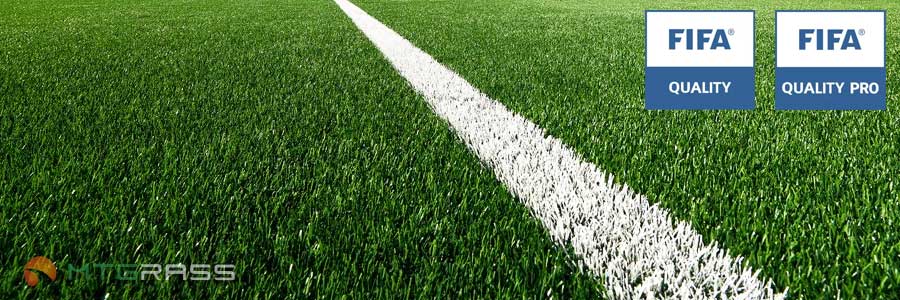
In modern sports facility construction, artificial turf football fields have become the preferred solution worldwide due to their high durability, low maintenance costs, and all-weather usability. Compared with natural turf, soccer synthetic grass can maintain good ball feel and resilience in adverse weather such as rain, snow, and extreme heat, while effectively reducing maintenance time and expenses and increasing field utilization. For schools, communities, clubs, and even international competition venues, synthetic grass for soccer fields is a high-return-on-investment choice.
Moreover, with FIFA’s promotion of artificial turf standards, artificial grass for soccer fields has become widely adopted in markets across Africa, the Middle East, Asia, and Europe, and is especially suitable for regions with scarce water resources or where natural turf maintenance is difficult.
1. FIFA football field dimensions and design requirements
According to the FIFA Turf of the Game and the standards of the FIFA Quality Programme, the dimensions and design requirements for football (soccer) pitches used in international matches are as follows:
Field Dimensions
- 11-a-side football pitch: Length 100–110 m, Width 64–75 m (105 m x 68 m commonly used in international matches)
- 7-a-side football pitch: Length 70–75 m, Width 45–55 m
- 5-a-side football pitch (Futsal): Length 38–42 m, Width 20–25 m
Safety buffer (Run-off area):
- At least a 3 m safety zone must be reserved around the perimeter of the field
- Field slope: Should maintain a drainage gradient of 0.5%–1%
- Pile height (Artificial turf height): Typically 40 mm–60 mm; FIFA recommends 50–55 mm
FIFA standards emphasize:
- Artificial turf must be certified by FIFA Quality or FIFA Quality Pro
- The field should have a good drainage system to ensure it can be used normally within 2 hours after rainfall
- Yarn should have UV resistance, abrasion resistance, and tensile strength to ensure a service life of over 8 years
2. FIFA Football Field Artificial Turf Standard Requirements
2.1 Material and Quality Standards
- FIFA Quality Programme awards two major certification marks to artificial lawns:
- FIFA QUALITY: Suitable for community, amateur and training purposes, 40–60 hours per week.
- FIFA QUALITY PRO: It is intended for professional competitions and requires higher athletic performance, safety and durability.
2.2 New version Test Manual (2024 edition). Introduced:
- Advanced Artificial Athlete (AAA) Test: Evaluate key parameters such as impact absorption, energy rebound, and deformation;
- Rotary Traction Athlete (RTA) test: Assessing rotational shear stiffness and torque performance;
- Head Injury Criterion (fall shock test) to improve head safety;
- Increase the number of wear-resistant cycle tests and enhance durability standards; introduce damping pads (shockpad) detection, use of recycled materials, etc., and optionally test the freezing condition.
3. FIFA Artificial Turf Technical Specifications
Sports artificial grass meeting FIFA Quality standards must satisfy the following technical criteria:
| Technical Parameter | FIFA Standard | Description |
| Yarn Material | 100% PE Monofilament or blended fibers | Provides better elasticity and wear resistance |
| Pile Height | 50–55mm | Optimal height for football play |
| Stitch Density | ≥10,000 stitches/㎡ | Enhances turf stability |
| Infill Ratio | Quartz sand + rubber granules | Provides cushioning and ball rebound |
| UV Resistance | 5,000 hours without significant fading | Ensures outdoor durability |
| Sports Performance | Ball speed, rebound, shock absorption meet FIFA test values | Guarantees consistent match experience |
4. FIFA Football Turf Manufacturer & Installer Qualifications
Only FIFA-licensed manufacturers can produce authorized turf and apply for FIFA standards (MightyGrass):
1. FIFA Preferred Provider (FPP):
- Must have integrated capability in civil works, installation, and maintenance.
- Provide full installation responsibility and after-sales information.
- Regularly report quality and compliance to FIFA
2. Field Design & Construction Standards
Pitch structure layers:
- Sub-base → Drainage network → Unbound crushed stone base → Leveling layer (asphalt or sand-gravel).
- Optional shockpad to enhance player experience and impact absorption.
Construction workflow:
- Bidding stage: Ensure the contractor has FIFA Quality or Quality Pro certification.
- Base construction → Drainage system installation → Turf installation and seaming → Infill application → Auxiliary facility installation.
- Warranty should be tied to usage hours and maintenance frequency.
Maintenance & daily care:
- Regular brushing with tractor-mounted equipment.
- Remove debris and contaminants; use drag mats and ball roll tests to monitor surface performance.
- Sprinkling for cooling or cleaning if needed; high-frequency watering generally unnecessary (FIFA Publications).
5. FIFA Football Field Construction Details & Key Points
Tender requirements:
- Must specify FIFA Quality or Quality Pro certification.
- Disclose maintenance responsibilities, performance guarantees, and warranty cycles.
Base construction quality control:
- Soil survey and drainage plan required.
- Layer compaction ≥95% to prevent surface settlement.
Turf installation details:
- Rolls cut and aligned precisely; seams fully bonded with no lifting.
- Infill (sand + rubber) applied evenly at consistent thickness.
Climate adaptation design:
- High-temperature areas may need cooling sprinklers.
- Fade-resistant yarn and UV-resistant material recommended if needed.
Testing & lab inspection:
- Samples submitted for testing; on-site dynamic testing conducted post-installation.
- Any construction defects must be repaired by the manufacturer within the warranty period.
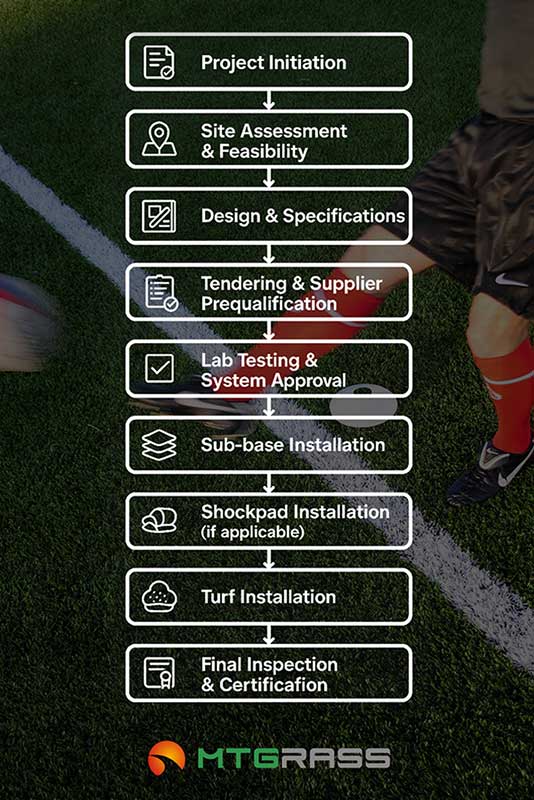
6. FIFA Football Field Construction & Standard Alignment Flowchart (Detailed)
This process strictly follows the FIFA Quality Programme for Football Turf four-phase methodology (Tender/Installation/Testing/Maintenance) and aligns with the 2024 Test Manual II for lab and field testing, ensuring final certification for FIFA QUALITY / QUALITY PRO.
Phase 1: Project Initiation & Goal Setting
- Core decisions: Certification level (QUALITY / QUALITY PRO), weekly usage hours, budget, timeline, applicable competition level.
- Standard alignment: Two-stage testing (lab + field), focusing on ball-surface & human-surface interaction, safety, and durability.
- Deliverables: Project charter, certification goals, budget framework, preliminary schedule.
MightyGrass recommendation:
- For professional or broadcast matches, target QUALITY PRO FIFA MT-DIAMOND.
- For high-frequency training/community use, QUALITY is acceptable, with focus on operation and maintenance.
Phase 2: Site Survey & Feasibility
- Key points: Soil survey, groundwater/drainage paths, orientation & glare, boundaries, access points, power/water supply.
- FIFA focus: Proper slopes, safety run-off areas, and equipment accessibility (brushes, drag mats, ball roll ramps).
- Deliverables: Survey report, feasibility study, overall site plan.
Phase 3: Design & Technical Specifications (TS)
- Design elements: Field dimensions (e.g., 105×68m for 11-a-side), slope (toward drainage or radial), drainage type (blind pipe/main pipe/sump), structure layers (crushed stone → leveling → optional shockpad → turf system).
- Technical specifications: Include FIFA testing & acceptance indicators (shock absorption, vertical deformation, rebound, rotational resistance, seam strength, weathering, wear cycles).
- Deliverables: Construction drawings, drainage & structural details, testing & acceptance checklist .
Phase 4: Tender & Supplier Prequalification
- Mandatory: Only FIFA Licensees / Preferred Providers can participate, ensuring qualifications, track record, warranty, and compliance traceability.
- Deliverables: Tender documents, scoring matrix, award notification, contract (with performance guarantee & retesting commitment).
MightyGrass tip: Include operational training, spare parts, and infill top-up in the contract to reduce total cost of ownership FIFA MT-UBEST 50.
Phase 5: Lab Sample Testing & System Finalization
- Turf yarn/backing/shockpad/infill sent to FIFA-authorized labs per Test Manual.
- Only certified system can be installed; one system per pitch.
- Deliverables: Lab certificate, sample approval, finalized BOM.
Phase 6: Base Civil Works & Drainage
- Key control points: Clearing/fill → compaction (records kept) → drainage pipes/sumps → crushed stone & leveling.
- Goal: Ensure flat geometry and effective drainage for field testing.
- Deliverables: Compaction, flatness, slope, drainage test reports.
Phase 7: Shockpad Installation (Optional)
- Purpose: Improve impact absorption, consistency, reduce reliance on infill thickness, extend performance life.
- Inspection: Thickness/density, seam overlaps, stress points check.
- Standard alignment: Contributes to rebound, vertical deformation, energy return in field tests.
Phase 8: Synthetic Turf Installation & Seaming
- Key points: Roll orientation, climate adaptation, seam tape + adhesive/sew strength sampling, embedded white lines consistent with main turf.
- Standard alignment: Seam strength and material uniformity verified per Test Manual.
Phase 9: Infill Installation & Mechanical Brushing
- Process: Layer sand first, then elastic infill, uniform thickness, moisture control, particle grading; mechanical brushing ensures consistent rebound & feel.
- Sustainable trend: Some regions explore black-free or bio-based infills (e.g., cork, olive pits) to reduce microplastics. Lab approval and field verification required.
Phase 10: Auxiliary Equipment Installation
- Includes goals, nets, lighting.
- Field lighting per event level; coordination with turf maintenance paths.
- Deliverables: Equipment certificates, installation & commissioning records.
Phase 11: Pre-Acceptance & Internal Testing
- Self-check: Ball roll, rebound, rotational torque, flatness/slope, seam & infill thickness.
- Establish punch list and complete corrections before inviting FIFA testing.
Phase 12: FIFA On-Site Testing & Certification
- Conducted by FIFA-authorized testers per Test Manual II (ball-surface, human-surface interaction, safety, durability).
- Successful pitch awarded FIFA QUALITY / QUALITY PRO certificate.
- Certification requires periodic re-inspection; Quality Pro intervals shorter than Quality.
Phase 13: Maintenance Handover & SOP
- Routine: Brush turf, remove debris, drag mat, ball roll checks, sprinkle if necessary; maintain rebound & ball speed.
- Deliverables: Maintenance manual, training records, equipment list, in-warranty maintenance plan.
Phase 14: Lifecycle Re-Inspection, Warranty & Upgrade
- Periodic re-inspection and infill top-up, repair seams, high-wear areas, or surface replacement (re-turf).
- Track KPIs: comfort, ball roll, rebound, injury rate, downtime.
MightyGrass recommendation: Include re-inspection/recertification in annual budget & field records to minimize season conflict and downtime FIFA-MT-Diamond-50.
7. FIFA-Certified Artificial Turf & Installation Cost Breakdown
The following table outlines the typical costs for constructing an 11-a-side football field (7,140㎡) in South America and Europe. All costs are indicative and subject to change based on local conditions, site surveys, and FIFA system certification plans.
| Item | Description | South America Estimated Unit Cost (USD/㎡) | Europe Estimated Unit Cost (USD/㎡) |
| FIFA-Certified Artificial Turf Materials | Includes yarn, backing fabrics; prices vary by brand and certification | $12–$25 /㎡ | $20–$40 /㎡ |
| Base Construction | Earthworks, foundation treatment, drainage system, crushed stone & leveling layer | $15–$35 | $25–$45 /㎡ |
| Turf Installation Labor | Includes roll deployment, seam joining, and overall installation | $6–$12 | $10–$20 /㎡ |
| Infill Materials | Quartz sand ($0.5–1) + Rubber granules ($1.5–3) | $2–$5 | $3–$6 /㎡ |
| Shockpad (Optional) | Enhances cushioning and safety | $3–$6 | $5–$8 |
| Laboratory & On-Site Testing Fees | Pre-certification sample testing + final inspection | $5k–$10k | $8k–$20k |
| Auxiliary Equipment & Facilities | Goals, lighting, protective nets, maintenance tools | $20,000–$50,000 | $40,000–$100,000 |
| Maintenance Equipment & Daily Cleaning | Tractor brush, ball roll tester, sprinkler system | Total $2,000–$10,000 | Total $10,000–$25,000 |
Total Estimated Budget for an 11-a-side FIFA Field
| Region | Total Cost Estimate (7,140㎡) |
| South America | $347,000 – $731,000 |
| Europe | $576,000 – $1,120,000 |
Note: These estimates are for guidance only. Final costs depend on local labor rates, materials, taxes, import fees, and compliance with FIFA certification standards.
8. FAQ
What Are MightyGrass’s Core Advantages?
Premium Materials & Advanced Technology
MightyGrass artificial turf is made from chemically synthesized fibers, combined with wear-resistant, UV-resistant, and high-rebound technologies. This ensures that every touch on the field is precise and comfortable for players. Whether it’s a professional league stadium, a school field, or a community football pitch, our turf can withstand high-intensity usage.
Customized Solutions
Every football field has unique requirements. From pile height, turf density, infill system, to drainage design, MightyGrass provides professional football field turf solutions to perfectly match the practical needs of your project.
Safety & Environmental Assurance
MightyGrass insists on using non-toxic, eco-friendly materials, passing strict quality inspections and international certifications. Players and users can enjoy football in a safe and comfortable environment.
Extensive Global Installation Experience
With rich overseas project experience—from schools and community pitches to professional club training grounds—MightyGrass artificial turf guarantees smooth implementation, high-standard installation, and long-term stable performance.
Choosing MightyGrass means choosing a safe, durable, and cost-effective football field artificial turf solution. Whether it’s a new stadium or a renovation project, we offer one-stop support from design, materials, and installation to after-sales service.
Contact MightyGrass today to get a personalized professional football field turf solution and bring professional energy to your pitch!