
 Svenska
  English
  العربية
  Español
  Deutsch
  Français
  Português
  Русский
  日本語
日本語  Italiano
  Nederlands
  Suomi
Suomi  ไทย
ไทย  Dansk
Dansk  Ελληνικά
  Bahasa Melayu
Are you ever confused by the many lines, arcs, and markings on a baseball field? A baseball field is one of the most precisely engineered sports surfaces in the world, and baseball field dimensions (from 90 ft basepaths to the 60 ft 6 in pitching distance) directly affects game strategy, ball travel, and player safety.
Whether you’re designing a new baseball field, renovating an existing one, or researching baseball field specifications for maintenance purposes, understanding these measurements is essential for building a safe and regulation-compliant playing surface.
In this article, we introduce all the baseball field dimensions and markings, including variations in field dimensions from Major League Baseball (MLB) to Little League, high school baseball, college baseball, and PONY League for different age groups, hoping to assist you in your future endeavors.
Baseball Field Layout
All baseball fields consist of two main parts: the infield and the outfield, collectively forming a fan-shaped playing area with a “diamond” shaped infield. The overall playing area includes fair territory, foul territory, warning tracks, and various field markings that dictate where players move during play.
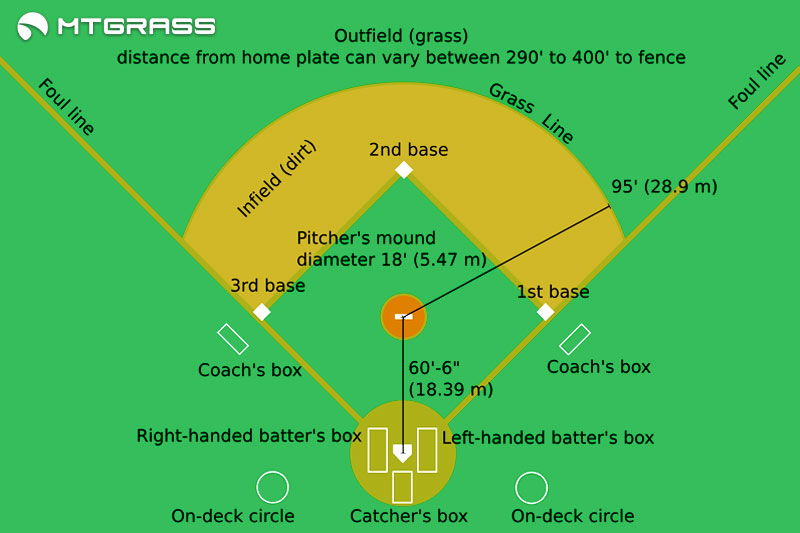
Baseball Field Diagram
We’ve used a baseball field diagram to visually outline its core dimensions, using a 90-foot square infield (suitable for MLB and college games) as an example:
- Home plate to first and third base distances
- Home-to-second diagonal distance: 127 ft 3 3/8 in
- Pitching mound location (60 ft 6 in from home plate)
- Outfield fence distances to left, center, and right field
- Foul lines extending from home plate to the outfield poles
- Because the outfield dimensions of MLB baseball fields are not standardized, the outfield dimensions may vary from one ballpark to another.
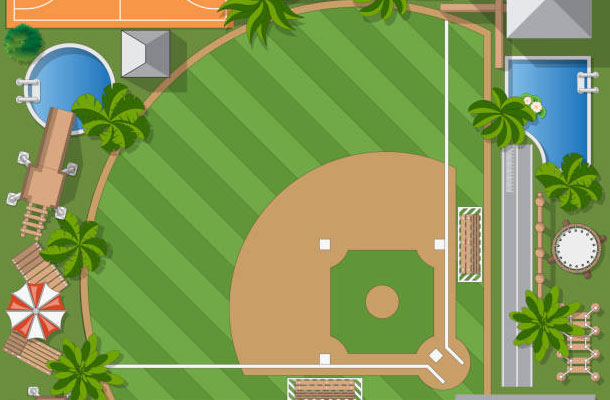
Baseball Field Map
A baseball field map shows the broader geography of the facility, including dugouts, bullpens, spectator seating, backstop from home plate, batter’s eye (center-field background), foul territory.

Baseball Field Numbers
Baseball uses a standardized field numbering system to identify defensive player positions:
- 1 — Pitcher
- 2 — Catcher
- 3 — First Baseman
- 4 — Second Baseman
- 5 — Third Baseman
- 6 — Shortstop
- 7 — Left Fielder
- 8 — Center Fielder
- 9 — Right Fielder
This numbering system appears in scorekeeping charts and baseball field diagrams to help explain play sequences such as “6-4-3 double play.”
Baseball Infield Dimensions
The infield of baseball fields includes the diamond-shaped infield, bases, home plate, pitcher’s mound, and the starting points of the foul lines. The pitcher throws the ball to the batter here, and the batter hits the ball and runs around the four bases surrounding the diamond-shaped infield. Below, we have listed all the components of the infield and their dimensions, using a 90 ft diamond-shaped infield as an example:
Diamant
The “diamond” refers to the square-shaped infield formed by the four bases. After hitting the ball, the batter runs along the outline of the diamond, deciding whether to stop at a base or complete a full circuit to achieve a “home run.”
- MLB, college, and high school all use a 90-foot diamond.
- Youth fields may use 60 ft, 70 ft, or 80 ft diamonds depending on age group.
Bases
- Standard Base Spacing: Distance between bases (MLB/high school) 90 ft. Distance is measured from the back corner of one base to the back corner of the next.
- Base Size: New MLB rule (2023) bases increased to 18 inches (previously 15″) to reduce the risk of collisions between batters and fielders. However, some high schools and universities may still use 15-inch bases.
Home Plate
Home plate has a unique five-sided shape: two 8.5-inch sides adjoining the point, two 12-inch sides, and a 17-inch front edge facing the pitcher
Foul Lines
Foul lines extend from the rear point of home plate, and along the edges of the baselines, up to the left-field and right-field foul poles.
A ball hit that lands within or outside the foul lines (beyond first or third base) is considered a “fair ball”; a ball that lands outside the foul lines is considered a “foul ball”.
Baselines
Baselines represent the 90-foot basepaths connecting home, first, second, and third base. And the base lines between home plate and first base, and between third base and home plate, overlap with the foul lines.
Running Lanes
The running lane is a line 3 ft wide and 45 ft long, drawn on the field parallel to the foul line and the first base line. Runners must stay within this lane when the ball is bunted or thrown to first.
Batter’s Box
The field has two 6 ft x 4 ft batting areas, placed on both sides of home plate. The batter’s box to the right of home plate is for left-handed batters, and the batter’s box to the left is for right-handed batters.
Catcher’s Box
The catcher’s box is a rectangular area behind home plate, measuring 8 feet by 43 inches. The catcher must stand within this area while waiting for the pitcher to throw the ball; if the catcher is not in the catcher’s box when the pitcher throws, it is ruled a pitcher’s balk.
Pitcher’s Mound
The baseball pitcher’s mound is a raised area of dirt located in the center of the diamond-shaped field, where the pitcher’s plate is situated and from where the pitcher throws the ball.
It’s 60 feet 6 inches from home plate, which constitutes the so-called “pitching distance,” and must be located on a raised pitcher’s mound that is 18 feet in diameter and 10 inches high.
The pitcher’s plate within the pitcher’s mound is a rectangular plate 24 inches long and 6 inches wide.
Coach’s Boxes
A baseball field has two coach’s boxes, one located outside the first base line and the other outside the third base line. Each coach’s box measures 15 ft by 35 ft, and the offensive team’s coaches stand within these boxes. Coaches must wear helmets and remain inside the coach’s box. They are responsible for guiding the base runners and sometimes exchange equipment, such as sliding gloves or protective gear.

Baseball Outfield Dimensions
The outfield refers to the open turf area beyond the infield. Its boundaries are defined by the foul lines, which must extend at least 320 ft from home plate down both sides of the field. Unlike the baseball infield—which follows standardized measurements—the size of the baseball outfield can vary significantly from one ballpark to another, including at the professional level.
Understanding outfield lengths is essential for field architects, facility owners, and turf installers, as it directly impacts gameplay, home-run probability, and the total square footage of materials, especially when installing artificial turf for baseball fields. The following are the official outfield dimensions for various major competition levels, for your reference:
Major League Baseball (MLB) Field Dimensions
MLB is unique because it allows variations in outfield size from stadium to stadium.
The deepest part of the outfield is known as center field. In most Major League Baseball (MLB) stadiums, the straightaway distance from home plate to center field is at least 400 ft. Detroit’s Comerica Park features the deepest center-field wall in MLB at 420 ft, while Boston’s Fenway Park has the shallowest at just 390 ft.
The areas on either side of center field are called left field and right field. In most MLB stadiums, these distances generally range from 320 ft to 350 ft. Wrigley Field in Chicago has MLB’s deepest right field at 353 ft, while Fenway Park again holds the record for the shortest right-field line at only 302 ft. Its left-field dimensions also represent the extremes in the league 355 ft for the deepest and 310 ft for the shallowest.
Because every MLB park is different, outfield geometry is a major part of team strategy and ball-flight analysis.
College and Middle School Baseball Field Dimensions
High school and college (NCAA) baseball field dimensions are almost identical to those of Major League Baseball (MLB) fields. The infield consists of a 90-foot by 90-foot diamond, with the pitcher’s mound 60 feet 6 inches from home plate.
The recommended outfield distances are: 400 feet from home plate to center field, and 300 feet from home plate to the end of the foul lines. The radius of the outfield fence should be adjusted based on these recommended distances. As mentioned earlier, the specific dimensions of each baseball field vary, hence the use of recommended distances.
Middle School Field Dimensions
Middle school baseball fields have slightly smaller infield dimensions, falling between Little League and high school fields. Common base distances are 70–80 ft, pitcher’s mound distance is 50–54 ft, and outfield fence distance is 225–275 ft.
Youth Baseball Field Dimensions (PONY & Little League)
Youth baseball fields vary significantly depending on age group and competition level.
The two most widely used systems worldwide are PONY Baseball and Little League Baseball.
Although both organizations follow similar developmental principles, their field dimensions—including basepath length, pitching distance, and outfield size—differ across age divisions.
Youth Baseball Field Dimensions Comparison Table:
| League System | Division / Age Group | Basepath Distance | Avstånd för pitching | Center Field Min. | Left / Right Field Min. |
| PONY | Shetland (3–4) | 50 ft | 38 ft | 200 ft+ | 125 ft+ |
| Shetland 6U (5–6) | 50 ft | 38 ft | 200 ft+ | 125 ft+ | |
| Pinto (5–8) | 60 fot | 38 ft | 200 ft+ | 125 ft+ | |
| Mustang (7–10) | 60 fot | 46 ft | 225 ft+ | 175 ft+ | |
| Bronco (9–12) | 70 ft | 50 ft | 275 ft+ | 225 ft+ | |
| Pony (11–14) | 80 ft | 54 ft | 315 ft+ | 265 ft+ | |
| Pony (13–16) | 90 ft | 60 ft 6 in | 350 ft+ | 300 ft+ | |
| Colt / Palomino (17–23) | 90 ft | 60 ft 6 in | 350 ft+ | 300 ft+ | |
| Little League | Tee Ball (4–7) | 50 ft | N/A | 200 ft+ | 125 ft+ |
| Minor League (5–12) | 60 fot | 46 ft | 200 ft+ | 200 ft+ | |
| Little League Major (9–12) | 60 fot | 46 ft | 200 ft+ | 200 ft+ | |
| Intermediate 50/70 (11–13) | 70 ft | 50 ft (adjustable) | 200 ft+ | 200 ft+ | |
| Junior League (12–14) | 90 ft | 60 ft 6 in (adjustable) | 300 ft+ | 300 ft+ | |
| Senior League (13–16) | 90 ft | 60 ft 6 in | 300 ft+ | 300 ft+ |
P.S..: Are you looking for durable, professional-grade artificial turf for your baseball field? MightyGrass, as a FIFA-godkänd tillverkare och leverantör av konstgräs, can provide you with baseball turf solutions suitable for all ages and skill levels, from MLB standards to youth league fields. We can match the appropriate pile height, density, and backing for your specific needs. Contact us today for more expert selection advice.
Baseball Field Architectural Design
When you design a baseball field, you’re not only shaping a playing space — you’re engineering how athletes move, how games flow, and how spectators experience each moment. A well-planned field enhances safety, visibility, drainage, and long-term maintenance performance.
A professional field layout must balance regulation geometry, athlete pathways, material selection, and site-specific engineering, including slope, orientation, and surface systems such as natural grass or synthetic turf.
Key architectural considerations include:
- Field Orientation: Avoiding sunlight interfering with the batter’s, pitcher’s, and fielders’ lines of sight is considered the “optimal orientation” – with home plate facing east-northeast. This is not a mandatory rule, but it is common practice in professional ballpark design and within the NCAA and MLB.
- Grading & Drainage: Ensure proper turtleback-shaped slope (usually 0.5–1%) to move water away from the infield and reduce game delays.
- Surface Selection: You can choose natural grass, a hybrid system, or artificial turf for the baseball field depending on the climate, intensity of use, maintenance capabilities, and project budget.
- Warning Track Design: A 10–15 ft wide warning track helps outfielders detect transitions.
- Player & Umpire Pathways: Allow safe, unobstructed movement around dugouts, bullpens, and coaching boxes.
- Spectator Lines of Sight: Ensure bleachers, dugouts, and fencing do not obstruct views of home plate and bases.
A solid architectural plan helps you create a baseball field that is durable, playable, and consistently safe for every level of competition.
How to Measure Baseball Field Dimensions?
Accurate measurement ensures your field meets the correct league standards—whether you’re preparing fields for youth leagues, high schools, colleges, or professional competition. You’ll need measuring tape (preferably 200–300 ft), marking tools, and field layout diagrams.
Below are the correct steps to measure each major dimension.
How to Measure Pitching Distance?
The pitching distance is measured from the front edge of the pitcher’s rubber to the tip of home plate (the back point). Steps:
- Locate the apex of home plate (the pointed back corner).
- Measure in a straight line toward center field.
- Mark the distance required for the league:
- 46 ft (Little League)
- 50 ft (Bronco, Pony)
- 54 ft (Intermediate leagues)
- 60 ft 6 in (High school, college, MLB)
- Install and level the pitching rubber at that exact point.
How to Measure Basepath?
Basepath length is the distance between consecutive bases, forming a square (diamond). Steps:
- Start from the back left corner of home plate (where the foul lines meet).
- Measure directly to the back corner of first base.
- Repeat the same distance between:
- First → Second
- Second → Third
- Third → Home
Standard basepath distances:
- 60 ft (Little League)
- 70 ft (Pony)
- 80 ft (Intermediate)
- 90 ft (High school, college, professional)
Tip: A 90-ft field is a perfect square — so the second base is 127 ft 3 3/8 in from home plate.
How to Measure Outfield Fence Distances?
Outfield fence distance is measured from the apex of home plate directly to the outfield fence at any given point. Steps:
- Place your tape measure at the apex of the home plate.
- Walk straight outward to the fence at:
- Left Field (LF)
- Left-Center (LC)
- Center Field (CF)
- Right-Center (RC)
- Right Field (RF)
- Record each measurement separately because outfields are not always symmetrical.
- Ensure your field aligns with league standards:
- Little League: 200–225 ft
- High School: 300–350 ft LF/RF, 350–400 ft CF
- College/MLB: varies by stadium but typically 320–335 ft LF/RF, 380–410 ft CF
How to Measure Home-to-Second Distance
The home-to-second measurement is taken diagonally, forming the long axis of the diamond. Steps:
- Place your tape at the apex of home plate.
- Measure diagonally across the infield to the back corner of second base.
- Standards:
- Little League (60 ft basepath): 84 ft 10 ¼ in
- 70 ft basepath: 99 ft
- 80 ft basepath: 113 ft 1 ⅝ in
- 90 ft basepath: 127 ft 3 ⅜ in (official senior-level measurement)
This diagonal measurement ensures all base angles are correct and the diamond is perfectly square.

Baseball Field Design Considerations
When you design a baseball field, you’re balancing athlete performance, long-term safety, and site engineering. Every detail — from field orientation to surface material — affects how the game plays and how well your facility performs over the years. Key design factors you must consider:
Infield vs. Outfield Interface
The transition between the dirt infield and the turf/grass outfield must be perfectly level. This avoids bad hops and reduces the risk of ankle injuries.
If you choose an artificial turf field, MightyGrass can provide you with a red artificial turf system for the infield, replacing clay and ensuring surface consistency and predictability.
Mound Construction
A properly engineered mound maintains firmness and provides consistent footing. Whether you’re using clay, clay bricks, or a synthetic turf mound system, stability is critical.
Surface Material Selection
Synthetic turf is increasingly popular because it provides all-weather play, less maintenance, and uniform ball response — especially in high-use facilities, schools, and municipalities.
Warning Track Design
A 10–15 ft warning track gives outfielders tactile feedback as they approach the fence. Materials (crushed brick, stone, or engineered warning track turf) should have contrasting color and texture.
Player Flow & Safety Zones
Ensure safe pathways around:
- Dugouts
- Bullpens
- Coaches’ boxes
- Spectator areas
Clear layouts reduce collisions and improve game flow.
Lighting & Foul Pole Visibility
You’ll need uniform lighting and unobstructed foul poles so players and umpires can track balls accurately.
Fence Heights
Depending on your level of play:
- 4–6 ft for youth
- 8 ft or higher for high school/college
- ≥8 ft or variable height for professional ballparks
What Are the Differences Between Baseball and Softball Field?
Softball is a variant of baseball, originally developed as an indoor sport, but later evolving into an outdoor sport suitable for adult women and children. Softball uses a larger, softer ball and a lighter bat, and can also serve as a safer and more effective way to introduce children to baseball, helping them master basic baseball skills and techniques. Although softball and baseball share many similarities, there are some important differences in field setup.
Baseball fields are larger, with 90-foot base distances, a longer pitching distance from the mound to home plate (60 feet 6 inches), and an overhand pitching style from a raised mound. Softball fields are more compact, typically with 60-foot base distances, a shorter pitching distance (35–43 feet), and an underhand fast-pitching style. The outfield in softball is also smaller than in baseball, resulting in a faster overall game pace.
Other differences include:
- Softball vs. Baseball ball size
- Softball vs. Baseball bat size and material
- Softball vs. Baseball pitching style
- Softball vs. Baseball rules
- Number of players on the field in softball and baseball
- Baseball gloves vs. Softball gloves
FAQ
How much artificial turf is needed to build a baseball field?
A full-size baseball field typically requires 90,000–120,000 sq ft (8,300–11,000 m²) of artificial turf. The exact area depends on:
- Level of play (Little League, High School, College, MLB)
- Outfield fence distances
- Whether you turf the infield only or the entire field
- The width of the warning track and foul territory
If you want a precise area calculation, you should start with your baseball field’s outfield distances and layout map.
How to calculate the total area required for turf installation?
To calculate turf area, you can use this simple method:
- Measure the radius from home plate to the outfield fence (left field, center field, right field).
- Calculate the sector area of the outfield.
- Add the infield area, including the 90 ft diamond and foul territory.
- Add extra zones such as the warning track, bullpens, and foul ground.
- For a quick estimate, many designers simply calculate: Field radius² × 3.14 × (degree arc / 360) + infield area
If you need assistance, please contact the professional team at MightyGrass immediately. You will not only receive information on artificial turf roll quantities but also a free factory quote.
How much does it cost to build a baseball field?
Baseball field construction costs vary based on size, materials, drainage, and location:
- Synthetic turf baseball field: USD $550,000 – $1.2 million
- Natural grass field: USD $200,000 – $500,000 (but higher long-term maintenance)
Major cost drivers include:
- Turf system (pile height, density, infill or non-infill)
- Shock pads
- Sub-base engineering and drainage
- Fencing, dugouts, bullpens, lighting
- Professionell installation
If you need assistance, please contact the professional team at MightyGrass immediately, and we will generate a complete cost breakdown for you.
Which type of artificial turf is best for baseball fields?
You should choose MightyGrass artificial turf engineered specifically for baseball performance:
- Shorter pile height (30–40 mm) for infield speed and ball roll
- High-density fibers for predictable hops
- Texturized yarn in the infield (for clay replacement zones)
- Longer pile (40–50 mm) in the outfield for ball absorption
- Shock pads (10–20 mm) for player safety
- UV-stabilized yarn for outdoor durability
Many modern baseball fields use non-infill turf for infields and infill systems for outfields.
Where can I download baseball field CAD drawings?
You can download baseball field CAD drawings from:
- NFHS, NCAA, or MLB specification manuals
- Sports field architecture libraries
- Turf manufacturers that provide layout templates
- MightyGrass technical support (custom baseball CAD available on request)
Where can I buy baseball turf, shock pads, and installation materials?
You can purchase complete systems from leading turf manufacturers and suppliers. MightyGrass provides:
- Baseball turf (infield & outfield)
- Shock pads
- Seaming tape & glue
- Silica sand & rubber infill
- Drainage base materials
- OEM/ODM custom turf solutions
How big is a high school baseball field?
High school baseball fields generally have:
- Basepaths: 90 ft
- Pitching distance: 60’6”
- Outfield fences:
- Left: 300–330 ft
- Center: 350–400 ft
- Right: 300–330 ft
High school fields follow dimensions similar to professional baseball, except for slightly shorter outfields in some regions.
How wide is the warning track on a baseball field?
A standard warning track is 10–15 ft wide along the outfield fence. MLB fields often use 15 ft, while high school and youth fields may use 10–12 ft depending on space and budget.
How long is a baseball field?
A baseball field does not have a universal “length” because outfield fences vary. Typical ranges include:
- Youth fields: 175–225 ft
- High school/college fields: 300–400 ft
- MLB fields: 310–420+ ft
- Center field is usually the deepest point.
What is the distance between bases in baseball?
The distance between bases is 90 ft at the professional, college, and high school levels. For youth baseball:
- Little League: 60 ft
- Pony League: 60–80 ft depending on the age division
What is the pitching distance in baseball?
Pitching distance measurements:
- MLB / College / High School: 60 ft 6 in
- Babe Ruth League: 60 ft 6 in
- Pony League: 54 ft or 48 ft (age-dependent)
- Little League: 46 ft
- Measure from the front of the pitching rubber to the back point of home plate.


